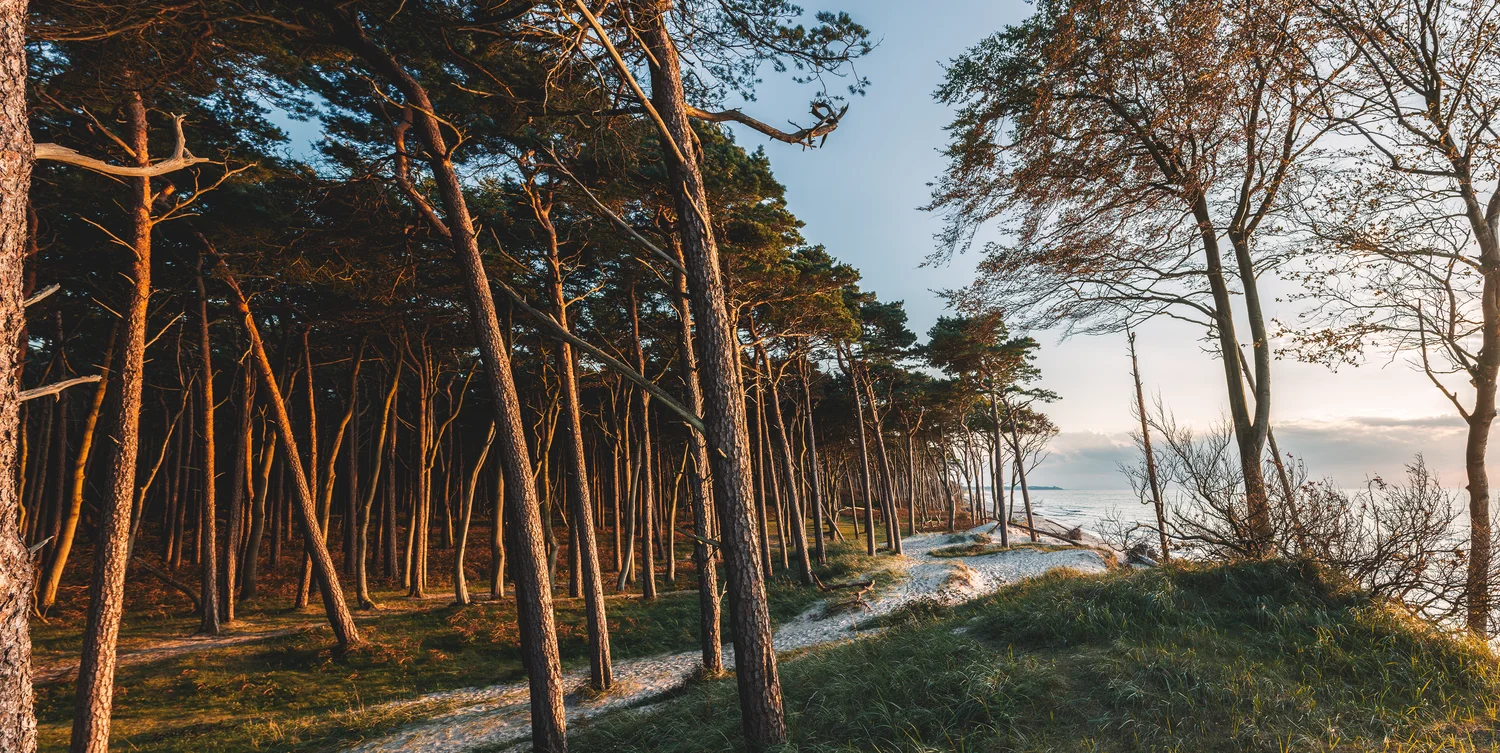
The Darss forest can add a woodland walk to a coastal holiday. Its paths belong to a protected landscape rather than an unrestricted network of shortcuts. A map, a clear turning point and attention to the return help prevent a small outing becoming an unexpectedly long walk.
Use an official map as the starting point
Consult information from the Western Pomeranian Lagoon Area National Park, which explains paths and visitor facilities. Choose a start you can actually reach and establish which routes are intended for walkers. Not every line in a general mapping application is a permitted shortcut. Core zones have a strict requirement to remain on paths; elsewhere too, the ground beside the route is wildlife habitat.
For a first visit, a manageable route with a known return is useful. A circuit can be pleasant, but only when its connections are understood. Any planned turn should be at an identifiable junction. Save the map before departure so navigation does not depend on mobile reception.
Do not connect forest and beach wherever convenient
If the coast is part of the walk, use an open authorised entrance. Sensitive beach sections may be closed for nature protection. A track through vegetation is not an official crossing. Count the journey to the beach and back as additional walking rather than treating it as a negligible extra.
Woodland can feel more sheltered than an open shore in a light breeze. In strong wind, however, it is not a safe fallback: branches may fall and trees can come down. Follow weather warnings and current park notices. Storm damage can remain after conditions appear calmer.
Avoid depending on a café
Carry water and something for a break. Not every path passes an open business. Stop at permitted places without entering vegetation or attracting animals, and take rubbish away. Dogs remain on leads as required, including on apparently deserted routes.
Decide before starting when you will turn back at the latest. Consider daylight, transport and the slowest person in the group. With children, an interesting section of path may already be the highlight; there is no need to force a distant endpoint. If navigation becomes uncertain, return to the last recognised place rather than trying successive unfamiliar turns. The forest is better enjoyed with time to observe than with a tight connection dominating the walk.